
Flashcards → live quiz → diagnostics
See how the classroom loop works.
Start with lesson material, build a reviewed deck, let students practise, run a live quiz, then use the evidence to decide what to revisit next.
1
Create flashcards
2
Students practise
3
Run live quiz
4
Diagnose & revisit
Why most studying doesn't work
Here's what probably happens when you study: you read through your notes, things start to feel familiar, and after a while it feels like you know the material. Researchers call this the fluency illusion — your brain reads familiar text smoothly, and mistakes that ease for actual knowledge.
The problem is that recognising something when you see it and being able to produce it when you actually need it are different things. Most tests want the second one.
Hippo is built around retrieval practice — being asked to recall information rather than just read over it. The research on this is consistent: it builds stronger, longer-lasting memories, and it does it in less time than re-reading.
What Hippo actually does
Hippo shows you each card just before you'd start to forget it.
Every time you rate how well you remembered something, the algorithm updates its estimate of when you'll need to see that card again. Cards you know well wait longer. Cards you keep forgetting come back soon.
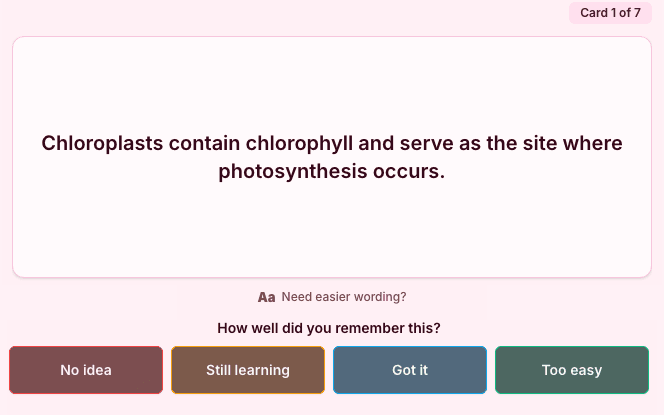
You don't manage any of this — you just study what appears, and the schedule gets more accurate the more you use it. Over time the gaps between reviews grow because the memories get stronger.
When you press Study, Hippo mixes cards from all your decks together. Switching between topics in one session feels harder — but that difficulty is the point. Your brain works harder to retrieve the answer, and that's what makes it stick.
Hard cards are the point
Think about learning to ride a bike. You don't get better by watching someone else do it — you get better by wobbling, nearly falling, and figuring out your balance through the experience of trying. Once it clicks, it stays. You don't forget how to ride a bike.
Retrieval practice works the same way. When a card feels difficult — when you have to genuinely work to remember — that struggle is the mechanism, not a sign something's gone wrong. The effort of trying to recall is what makes the memory stick. Flipping the card as soon as you're unsure means you see the answer, but you haven't built anything.
Spend twenty or thirty seconds actually trying before you look. That's where the learning happens. If everything feels easy, that's fine — those cards are well-consolidated and the algorithm will space them further out. The hard ones are where progress is being made.
Making your own cards helps too
Your teacher will probably give you decks to study. It's worth adding your own alongside them — especially for the parts of a topic you're least sure about. Writing a card means working out the question and putting the answer in your own words. That process is itself a form of studying, before you've reviewed anything. Try five to ten cards on the things you found hardest in a lesson. You've already reviewed the material once just by making them.

Getting started
If your teacher uses Hippo
Get the class join code, create an account, and your assigned decks will appear. Study what the app shows you, in the order it shows it. The algorithm has more data on your memory for each card than your intuition does — let it decide what to show you next.
If you're starting on your own
Create an account and build a deck for whatever you're studying. Ten to twenty cards on one topic is enough to begin. Study for ten minutes. Come back tomorrow. The spacing starts to compound after a few sessions.
One rule either way: when a card appears, actually try to remember before you flip it. That's the part that works. Everything else is just delivery.