Flashcards → live quiz → diagnostics
See how the classroom loop works.
Start with lesson material, build a reviewed deck, let students practise, run a live quiz, then use the evidence to decide what to revisit next.
1
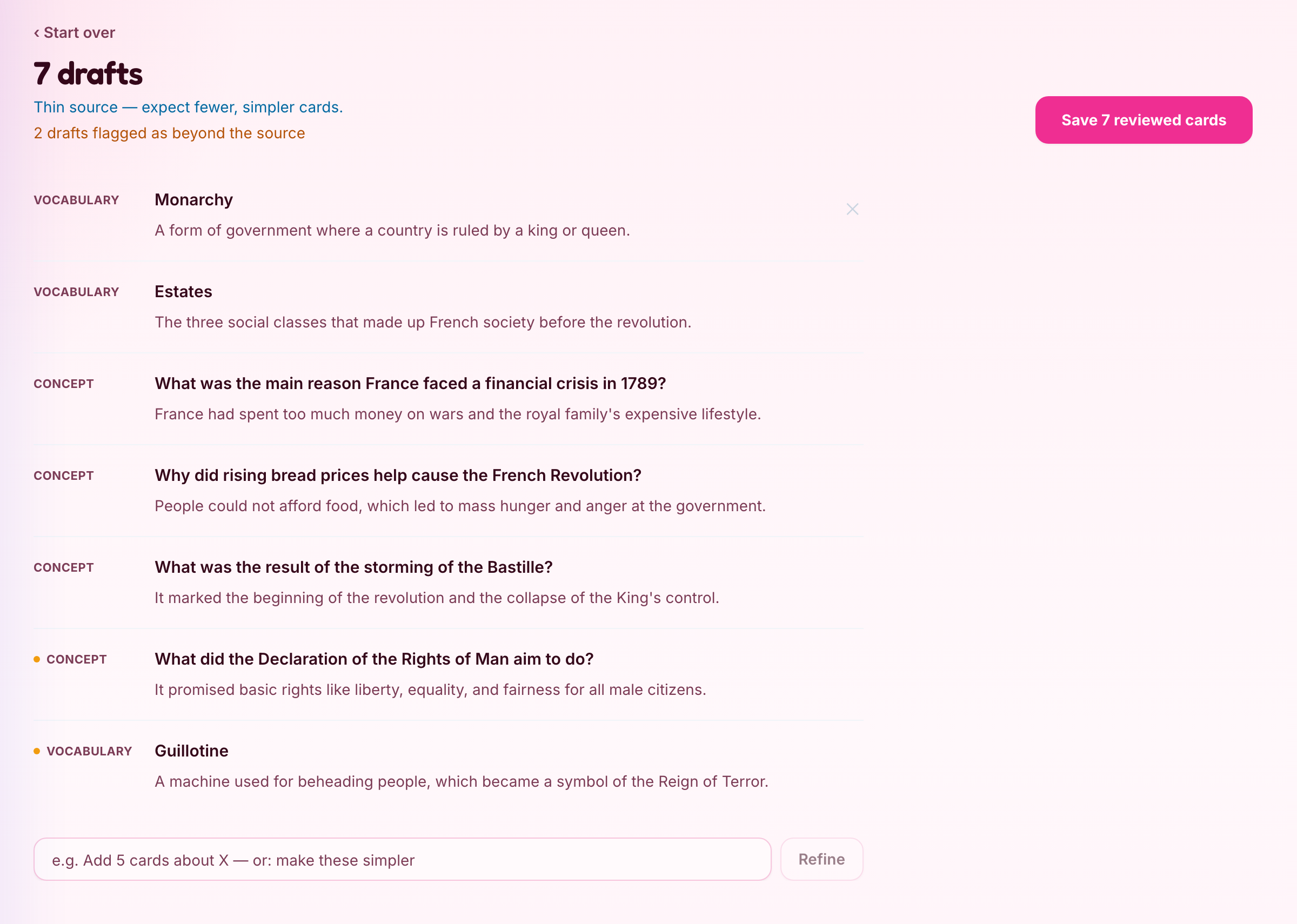
Create flashcards
2
Students practise
3
Run live quiz
4
Diagnose & revisit
What Hippo is for
Hippo is a learning system for classrooms — one important thing first: it's designed for what happens after a lesson, not during it. Retrieval practice consolidates understanding that's already been established. Students should encounter a concept through instruction, discussion, or worked examples before they practise it on Hippo. The platform is for what comes after, not what comes during.
With that in place, Hippo bridges the gap between what you teach and what students actually hold onto — not just in the days after a lesson, but weeks later when it matters. It doesn't change how you teach. It works beneath what you already do, giving students a structured way to retain what you've covered and, over time, to take more ownership of how they learn.
Three things the research is clear on
Retrieval beats re-reading. Actively recalling information produces more durable memories than reviewing it passively. The effort of retrieval — even when students are unsure, even when they need another attempt — is what builds the memory trace.
Spacing beats cramming. Reviewing something on Monday, Thursday, and the following week produces far better retention than reviewing it three times in one sitting. The gaps are where consolidation happens.
Difficulty is the signal, not the problem. Robert Bjork’s work on desirable difficulty shows that conditions that feel hard tend to produce the most durable learning. Students often misread struggle as failure. It usually means the opposite.
Hippo is built around all three. Every session is a retrieval event, every review is timed to arrive just before forgetting, and the cards that feel hardest come back most often.
The loop
Teach
This is what you already do. Students encounter concepts in context first — through your instruction, discussion, or worked examples. Hippo begins after that.
Practise
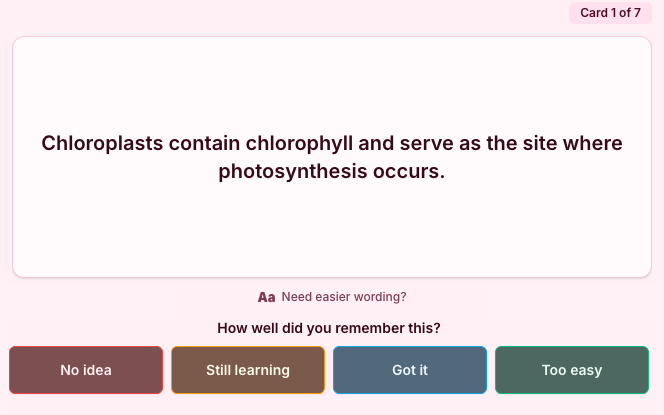
Students study independently. Harder cards come back sooner; known cards wait longer. Study mixes cards from active decks so practice feels varied, not crammed.
Live Mode
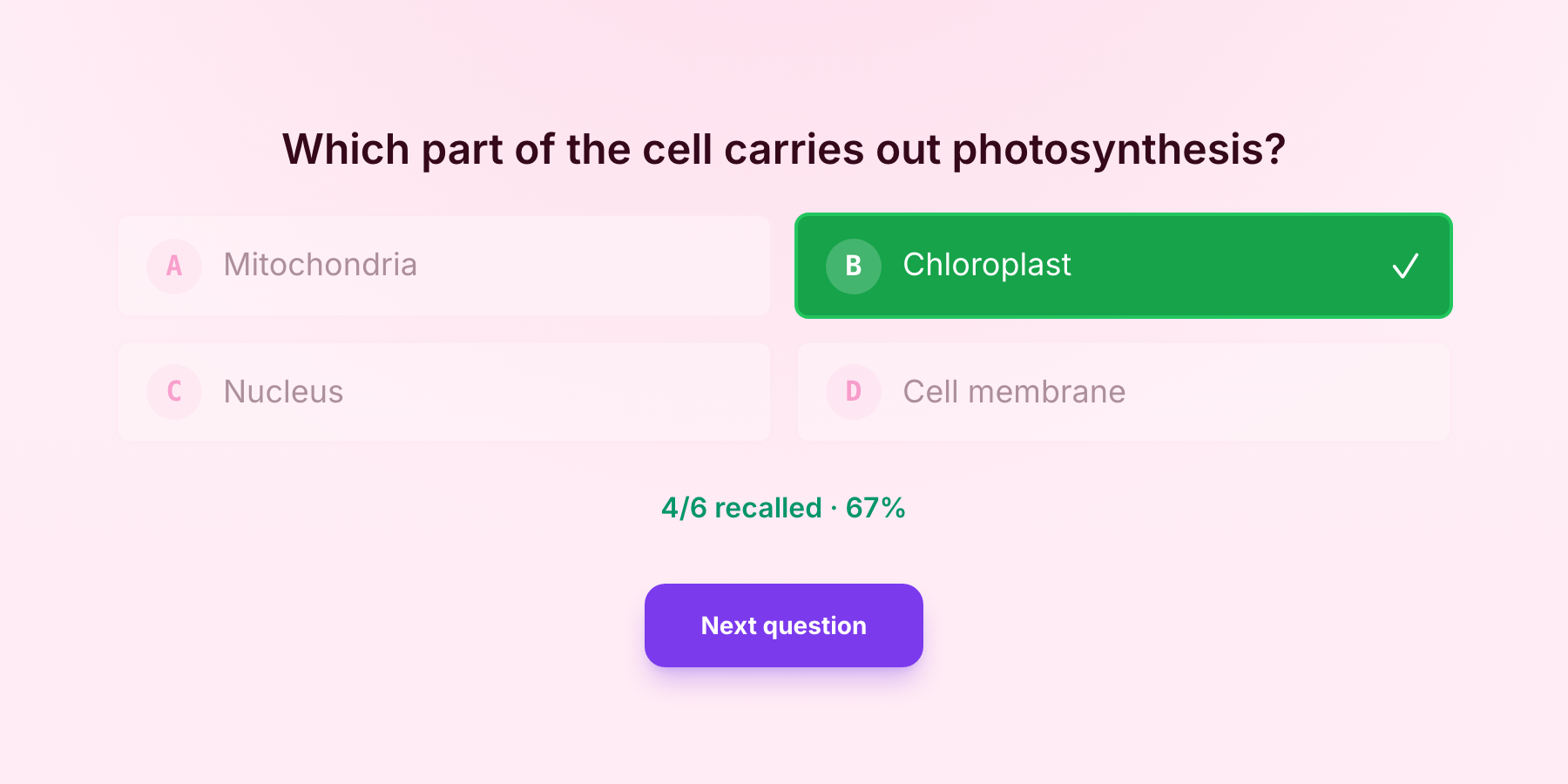
Individual practice becomes collective. Students join on their phones or laptops, you control the pace, and response distributions show what needs a reteach before students leave.
Who creates the cards matters — and it's not simple.
Research on the Generation Effect (Slamecka & Graf, 1978; Pan et al., 2022) shows that constructing a card is itself a learning event — writing the question requires understanding the material well enough to express it. For students who are confident and ready, making their own cards deepens engagement and strengthens encoding before they ever review.
But the research on teacher-created decks tells a different story. A 2025 study by Ingebrigtsen and colleagues found that students who studied with well-crafted teacher-made cards were significantly more likely to pass their exams — particularly students who were newer to independent study or who hadn't yet developed the confidence to identify what matters in a topic.
The practical implication: start with teacher-created decks, especially early in a unit. As students grow in confidence, invite them to extend the deck with cards of their own — on the concepts they found hardest, in their own words.
The post-session report shows which cards surfaced the clearest support needs and disagreement — your reteach priorities, available before you leave the room.
Your first week
Create an account, a class, and a deck of 10–20 cards on something you’re currently teaching. Assign it.
Students join and study independently. The algorithm begins building a profile for each one.
Run your first Live Mode session — Standard Mode, 10–15 cards, around 15 minutes. Review the report.
Reteach what didn’t stick, add cards as you cover new content, try Peer Instruction Mode on a concept where you know misconceptions are common.
Standard Mode and Peer Instruction Mode
Live Mode has two formats: use Standard Mode for a quick diagnostic, or Peer Instruction Mode when disagreement is useful and students should argue from evidence before the reveal. Students join on their own screens with nicknames and avatars — the round ends on a podium.


Standard Mode
Questions run, answers reveal, and you see at once how much of the class recalled it. Fast and clean as a diagnostic. Best for knowledge-level cards where you want a quick read on what's sticking.

Peer Instruction Mode
Based on Eric Mazur's method, developed at Harvard and replicated across subjects and age groups for thirty years. After students respond, Hippo shows the distribution but withholds the answer. If there's genuine disagreement, the teacher pauses: find someone who answered differently and convince them — or be convinced. Students discuss, then revote, then the answer reveals.
The post-session report shows first-vote and second-vote distributions for each card, and the delta between them — a direct measure of how much peer discussion moved understanding. A card that moved from 40% to 85% recalled after discussion tells you something different from one that stayed uncertain.
Standard Mode works well for knowledge-level cards. Peer Instruction Mode is more powerful for understanding-level cards, where plausible alternative answers and disagreement between students reveal something real.
Choosing the right card
A practical sequence: introduce new units with Prediction cards, build with Concept and Cloze, add Multiple choice once students have some familiarity, introduce Find the error when you've seen a specific misconception appear in student work.
Creating decks
The AI generator is designed to make this quick. Type a topic or paste existing lesson notes or a worksheet excerpt, and Hippo drafts a deck for you to review, edit, and assign. Teachers have materials — the AI turns them into cards.

One principle that matters: review AI-generated cards before assigning them. The AI can get subject-specific content wrong. You're the expert; it's the drafter.
Setting the level
The grade / year dropdown sets how advanced the ideas are and what students are assumed to already know. Language support sets the reading load: Standard uses normal classroom English; EAL support keeps the same ideas in plainer sentences. During study, any student can tap “Need easier wording?” on a revealed card to get a simpler version at their own reading level.
What the data shows you
After each Live Mode session, the report shows recall by card, response distributions, and which cards surfaced support needs or disagreement. This is practice evidence for your reteach list — a teaching decision made before the next lesson rather than after the next test.
The individual analytics view shows each student's progress over time — how reliably they're recalling cards in each deck, from just getting started through to recalling almost everything consistently. The most useful diagnostic is the gap between card types for the same concept: a student who recalls Concept cards but still needs support on Find-the-error cards for the same material may have surface recall without underlying understanding.
Student data is private. Students see their own data. Teachers see their class. Nothing is shared externally.
Try Hippo with one lesson you already have.
Start with one class. See the difference in six weeks — about two to three full review cycles.